Provenance

It is widely posited, and in some cases documented, that modern karate systems are derived either partially or entirely from Southern Chinese gung-fu forms. For instance, Kanryo Higashionna, progenitor of today’s Goju-ryu, spent the better part of ten years in Foochow, Fukien province studying martial arts. Kanbun Uechi also spent a decade in Foochow, independently of Higashionna, studying a form of Chinese boxing called Pangai-noon. Upon returning to Okinawa, Uechi moved to Wakayama Prefecture on the mainland and began teaching “Pangainun-ryu Todijutsu,” today known as Uechi-ryu Karatedo. The “crown jewel” of Matsubayashi-ryu kata, Kusanku, is named after an 18th century Chinese diplomat from Fukien province to whom we trace lineage.

Some forms are thought to have melded with native Okinawan fighting arts, as well as other forms of bujutsu introduced by the occupying Satsuma samurai (the makiwara, for instance, is storied to have been derived of the striking post used in Jigen-ryu kenjutsu) to produce the karate we know today. Other influences from Japan include the keikogi (training uniform), the dan/kyu (you’re welcome!) system, the shogo system of titles (renshi, kyoshi, hanshi), line drills for mass instruction, and perhaps even the concept of the formal dojo for training as early karate was practiced by small groups in less formal and structured environments.

In any case, the following video outlines various Southern Chinese systems of Guangdong province, next door to Fujian (Fukien), some of which bear a striking resemblance to the techniques and kata of Shorin-ryu. A survey of Southern White Crane would also reveal a resemblance to kata of both Goju-ryu and Uechi-ryu. Although our various styles have evolved over the generations to become unique unto themselves, rather than thinking about who and which is “better” than the other it is more interesting to identify our common ancestries and the principles therein which transcend system or style.

The Level of Training Was Different

This article, about our dojo advisor Art Ishii sensei of Little Tokyo Dojo in Los Angeles, CA, was initially published on January 2, 2014 as original content for Discover Nikkei, a global online resource for Japanese emigrants and their descendants. Discover Nikkei is a project of the Japanese American National Museum.

Art Ishii began his judo training in 1954 at Hollywood Judo Dojo in Los Angeles, CA, under the direction of senseis Takashi Kikuchi, Frank Emi, Art Emi, Frank Watanuki, and Gene LeBell. Upon his induction into the Air Force in 1962, he was sent to Sheppard AFB in Texas.
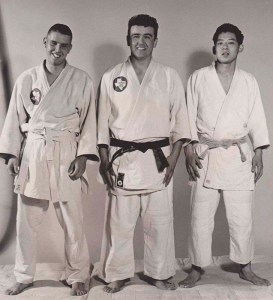
Art Ishii (right) with Sheppard Air Force Base Judo Club teammates, early 1960s. Photo courtesy of Art Ishii

Art Ishii (right) with Sheppard Air Force Base Judo Club teammates, early 1960s. Photo courtesy of Art Ishii.

“As an anonymous brown belt out of Hollywood Dojo,” he explains, “I was beating sandans (3rd degree black belts) in Air Force tournaments. I couldn’t believe it. It was a testament to the quality of training I’d taken for granted.”

He continued to train at Hollywood Dojo whenever back in Los Angeles on leave, and despite medaling in Air Force tournaments, remained nothing more than an “anonymous brown belt” in his home dojo.

“I never told my senseis of my tournament success in the military,” he reflects. “They would have laughed at me. It’s not that I was that good; the level of training was different. The first time I scored an Ippon (a match-winning full point) against a black belt in a military tournament I thought it was a mistake. But then it happened again. And again. I couldn’t understand it. Though as soon as I got back to Hollywood Dojo, that ride was over. I was a ‘C’ student at best in our dojo, absolutely nothing special, and to this day unremembered. After a while, into my mid-twenties, my body couldn’t take the abuse anymore, so I decided to investigate stand-up arts.”

His first foray into stand-up arts was while still in the military. A fellow airman needed a sparring partner for boxing, and Art made a deal with him that “for every round he beat on me in the ring, we’d spend an equal round on the judo mat. I was no match for him in boxing, but he was no match for me in grappling, so it really became a nice mutual exchange of training where we honestly developed a healthy respect for each other.”

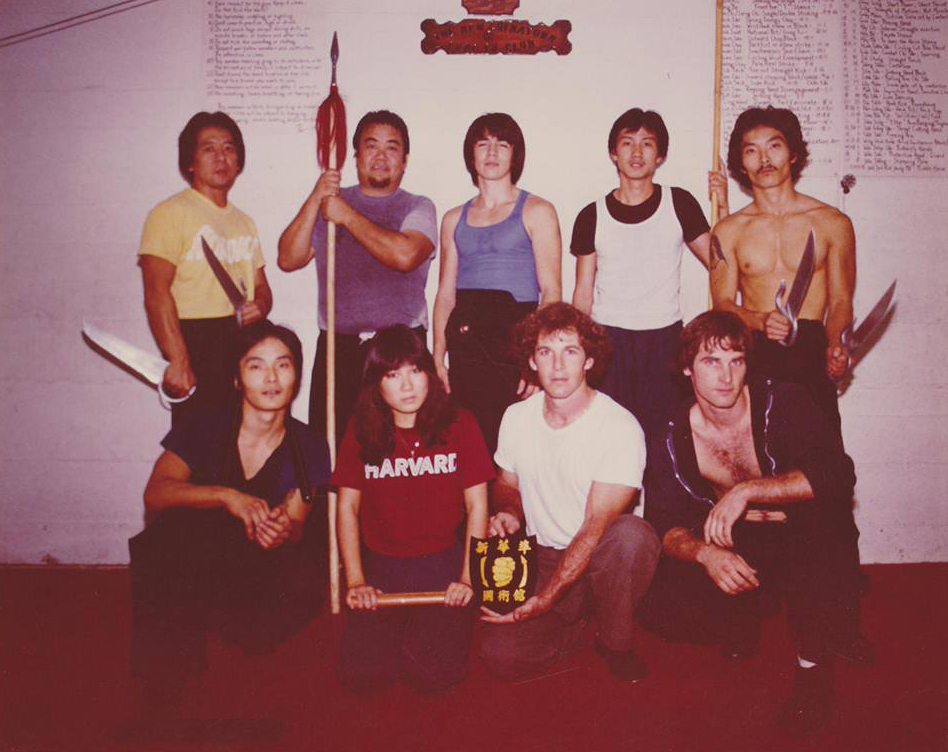
Art Ishii (second row, left) with the New Chinatown Gung-Fu Club, under the direction of Randy Williams Sifu (second row, center), early 1980s. Photo courtesy of Pete Farino.

Art Ishii (second row, left) with the New Chinatown Gung-Fu Club, under the direction of Randy Williams Sifu (second row, center), early 1980s. Photo courtesy of Pete Farino.

After the military, Art trained in Wing Chun for a number of years at the New Chinatown Gung-Fu Club under Randy Williams Sifu, an LA Chinatown native who today, having apprenticed under such notables as George Yau Sifu, Augustine Fong Sifu, and Ho Kam Ming Sifu, leads the Close Range Combat Academy, an international Wing Chun Gung-Fu organization. These many years later, the two remain close friends and exchange training at Art’s dojo whenever Randy’s travels bring him back to Los Angeles.

Art next trained in Goju-ryu Karate at Tenri Dojo in Boyle Heights, on Los Angeles’ Eastside, with the late Guy Kurose Sensei. Guy, a Sansei (third generation Japanese American) like Art, grew up in Seattle but had attended college at Tenri University in Nara, Japan. While there, Guy joined the karate club under Kenzo Uchiage Sensei from whom he earned his black belt and, unprecedented as an American in Japan at the time, not only became a collegiate kumite (sparring competition) champion, but captained the karate team his senior year.

Guy Kurose Sensei (left) with Art Ishii in Los Angeles' Little Tokyo, mid-1980s. Photo courtesy of Art Ishii.

Guy Kurose Sensei (left) with Art Ishii in Los Angeles’ Little Tokyo, mid-1980s. Photo courtesy of Art Ishii.

Four years at Tenri Dojo introduced Art to, as he puts it, “ten push-ups and two hours of world-class sparring, three times a week. Shuji Koshimizu (another Japan collegiate kumite champion) was there for a while,” he continues, “and Guy’s brother Rollie would visit, too. Man, watching Guy and Rollie spar was like admiring a moving work of art—beautiful, beautiful technique and spirit. In four years, though, I didn’t learn a single kata (the formal, choreographed exercises of karate).”

Upon Guy’s return to Seattle, Art was referred to Eihachi Ota Sensei’s Shorin-ryu karate dojo near the intersection of Olympic and Crenshaw Boulevards. A native of Okinawa, Ota immigrated to the United States in 1969 to help a friend run an already established karate dojo, despite his having recently graduated from an electronics college in Tokyo. Passionate for the art since childhood, and having trained for many years under Masao Shima Sensei of Naha City, Okinawa—whose dojo was also well-noted for its kumite—Ota eventually established his own dojo in Los Angeles 1973.

In the early 1990s, after ten years at Ota’s dojo and with a cumulative forty years of martial arts experience under his belt, Art accepted an invitation by Centenary United Methodist Church, a long-standing Japanese American congregation in LA’s Little Tokyo, to begin a karate program out of their social hall. Never having considered himself an instructor, he relates, “The first time someone called me ‘Sensei,’ I looked around the room going, ‘Where? Did Frank Emi just walk in? Guy? Oh man, they’re talking to me!’”

Twenty years later, Art Ishii continues to run Matsubayashi Shorin-ryu Dojo of Little Tokyo as a community-based entity at Centenary UMC. “Becoming head instructor of my own program was never my intention,” he says, “but life is unpredictable. Honestly, I’m glad it happened. It’s helped me to grow as a person these past twenty years, share some measure of our unique Japanese American culture, and serve the Little Tokyo community in some capacity, no matter how small.”

Although he teaches traditional Okinawan karate, Art remains true to his varied experience and frequently hosts highly regarded guest instructors of various styles to teach segments of his class. “Regardless of system or style,” he says, “good karate is good karate. And even more than that, good martial arts concepts transcend system or style so for instance, Randy can come in here and teach us something about our karate through his research into Wing Chun because although on the surface the two arts may look different, we all stick to some very fundamental concepts of training.”
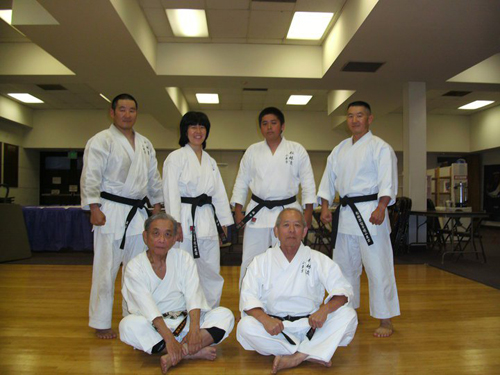
Guest instructor Rei Fujikawa Sensei (seated, left) of Shotokan karate, a former team member of Hidetaka Nishiyama's legendary 1970s kumite team, assists Art Ishii (seated, right) in running a black belt workshop at Art's dojo in 2012. Standing, from left to right, are dojo members Randal Kumagai, Cynthia Nishinaka, Walter Nishinaka, and Russell Kumagai. Photo courtesy of Matsubayashi Shorin-ryu Dojo of Little Tokyo.

Guest instructor Rei Fujikawa Sensei (seated, left) of Shotokan karate, a former team member of Hidetaka Nishiyama’s legendary 1970s kumite team, assists Art Ishii (seated, right) in running a black belt workshop at Art’s dojo in 2012. Standing, from left to right, are dojo members Randal Kumagai, Cynthia Nishinaka, Walter Nishinaka, and Russell Kumagai. Photo courtesy of Matsubayashi Shorin-ryu Dojo of Little Tokyo.

2014 marks Art’s sixtieth year of martial art practice; even so, he never forgets where it all started:

“My senseis at Hollywood Dojo were remarkable gentlemen of extraordinary character. Their aim in training wasn’t simply to beat people up or choke anyone out, but to bring up a new generation of respectable citizens.

“I was fortunate to get to know some of them on another level through community work in my adult life, and even then, long after having had my own lifetime of experiences from being in the military to getting married, building a family and a career, and then even much later running my own dojo, I could still never bring myself to call them by their first names. They will always be ‘Sensei’ to me.”

© 2014 Erik Matsunaga
Ryu Shin Karate Dojo Grand Opening & Seminar in Toronto, ON

We just returned from a weekend in Toronto to celebrate the opening of Tony Gibson-sensei’s new dojo, Ryu Shin Karate Dojo, and participate in the accompanying seminar featuring WMKA President Yoshitaka Taira-sensei, who’d traveled from Okinawa, and Shigehide Akamine-sensei of Argentina. Also in attendance were Matsubayashi-ryu practitioners from New York, Ohio, and Florida, as well as many seniors including Frank Baehr-sensei, who introduced Matsubayashi-ryu to Canada nearly fifty years ago.

WMKA President Yoshitaka Taira-sensei leads the group through warm-ups.

WMKA President Yoshitaka Taira-sensei leads the group through warm-ups.

The last we saw Taira-sensei and Akamine-sensei was in 2000, at the WMKA World Seminar hosted by our parent dojo, Matsubayashi Shorin-ryu of Little Tokyo. At that time they accompanied the second Matsubayashi-ryu headmaster, Takayoshi Nagamine-sensei, as well as Yasuharu Makishi-sensei, both of whom have since passed on.

Staging for the Nisei Week Parade at 308 Crocker Street in Los Angeles' Little Tokyo, during the 2000 WMKA World Seminar. Makishi-sensei, Akamine-sensei, and Taira-sensei stand front row, center, as Higashi Honganji Buddhist Temple looms in the background.

Staging for the Nisei Week Parade at 308 Crocker Street in Los Angeles’ Little Tokyo, during the 2000 WMKA World Seminar. Taira-sensei, Akamine-sensei, and the late Makishi-sensei stand front row, center, as Higashi Honganji Buddhist Temple looms in the background.

During the closing dinner, we were all treated to an extra-special surprise as Taira-sensei presented Akamine-sensei with a certificate pronouncing him 9th Dan, Hanshi, thus making Akamine-sensei the highest ranked Matsubayashi-ryu practitioner in the Americas and Europe. It was a rare and moving experience to witness such an honor bestowed upon a true gentleman and exemplar of our art.

Taira-sensei presenting Akamine-sensei a promotion to 9th Dan, Hanshi.

Taira-sensei presenting Akamine-sensei a promotion to 9th Dan, Hanshi.

In all, it was a memorable weekend of training and camaraderie, and a true celebration of the spirit of Matsubayashi-ryu. Congratulations to Tony Gibson-sensei and all the best for the future success of Ryu Shin Karate Dojo. Thank you for sharing the occasion with us. Ganbatte!

Visitors from L.A.

Traci Kato-Kiriyama and Ryan Suda took an evening to train at our dojo, while in town from Los Angeles on unrelated matters. Traci is a multi-disciplinary artist and community organizer (Tuesday Night Project, etc.), and Ryan is the man behind the curtain at Blacklava Designs, a well-regarded Screen Printing/T-Shirt Printing shop and store for all things Asian American. Thanks for stopping in, we love having visitors!

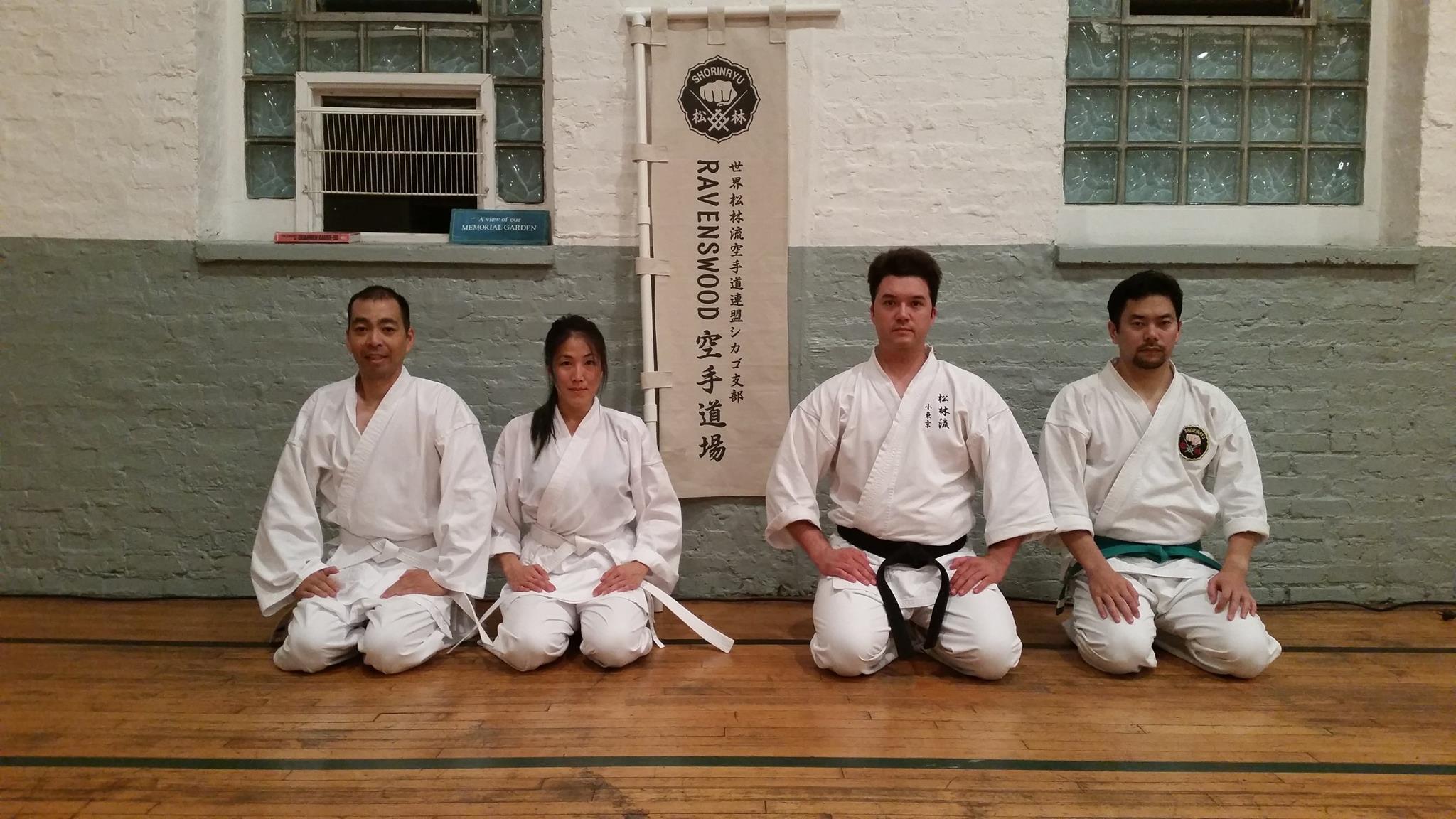
Suda brought the “Nobori” banner, made by Blacklava, as a gift to the dojo. Check out their work if in need of custom shirts or banners!

http://www.yelp.com/biz/blacklava-torrance

L-R: Ryan Suda, Traci Kato-Kiriyama, Erik Matsunaga, Ryan Yokota

L-R: Ryan Suda, Traci Kato-Kiriyama, Erik Matsunaga, Ryan Yokota

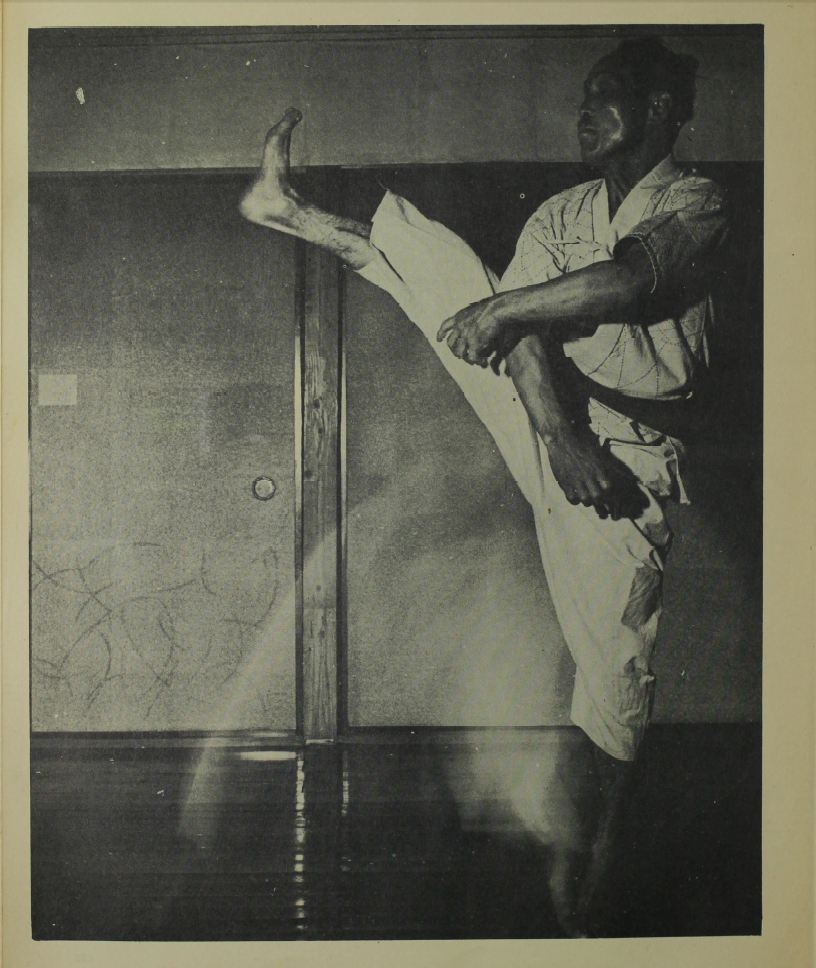
Karate Featured in Nisei Vue Japanese American Pictorial Magazine in May, 1949

A native of Shuri, Okinawa, Kanken Toyama (1888-1966) was born of hereditary nobility and began his martial arts training as a youth with such luminaries as Anko Itosu (Shuri-te, predecessor of Shorin-ryu and Shotokan), Kanryo Higashionna (Naha-te, predecessor of Goju-ryu), and Ankichi Arakaki (Tomari-te, predecessor of Matsubayashi-ryu). A schoolteacher by trade, at forty-two years of age he relocated to Tokyo to establish a karate dojo called Shudokan.

Toyama2This brief article was featured in a 1949 issue of Nisei Vue, a photographic Japanese American lifestyle magazine published in Chicago, IL. One of the earliest reports of karate in English, it may have been the first report by and for the mainland Nisei (second generation Japanese Americans) about the art form, which was effectively unknown to the non-Okinawan Nikkei community prior to Tsutomu Ohshima’s introduction of Shotokan to Los Angeles’ Little Tokyo community during the annual Nisei Week celebration in 1957.

Toyama1Courtesy of Densho – www.densho.org – who has archived Nisei Vue and Scene magazines online.

2014 Chicago Nikkei Community Annual Memorial Day Commemoration

This article was initially published on June 3, 2014 as original content for Discover Nikkei, a global online resource for Japanese emigrants and their descendants. Discover Nikkei is a project of the Japanese American National Museum.

In 1935, the Japanese Mutual Aid Society of Chicago began purchasing burial plots at Montrose Cemetery on the city’s North Side. Due to discriminatory policies of the time, Montrose was one of only a few cemeteries in the area that would inter the remains of deceased persons of Japanese ancestry. In 1937 the Mutual Aid Society erected a Japanese Mausoleum and in 1938 began hosting an annual Memorial Day commemoration.

Posting of the Colors by members of Chicago Nisei Post #1183

Posting of the Colors by members of Chicago Nisei Post #1183

The majority of Japanese Americans in the Chicago area today are descendants of late 19th and early 20th century immigrants who, along with their American-born children, fell victim to President Franklin D. Roosevelt’s Executive Order 9066, which forcibly removed all persons of Japanese ancestry from the West Coast in 1942, spreading them among ten concentration camps further inland.

Click here to read the rest of the article . . .

Teriyaki Chicken BBQ at RFUMC

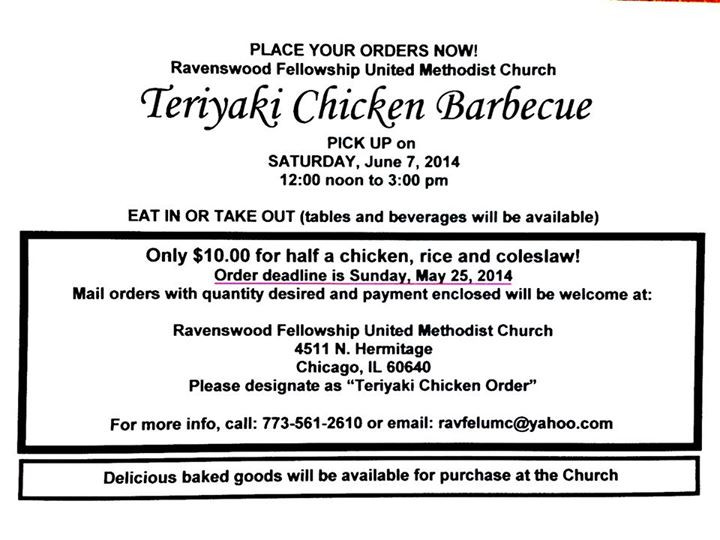
For those in the Chicago area, Saturday, June 7th is Ravenswood Fellowship UMC’s annual Teriyaki Chicken BBQ. Chicken Teri charcoal grilled in outdoor racks over a cinder block pit – the aroma wafts for blocks! Come support our dojo host!

This is a “pre-order” event with eat-in or take-out. $10.00 gets you a half chicken, scoop of rice, and coleslaw. Order deadline is Sunday, May 25th. For more info, call or e-mail the church office, or ask us!